I am often asked for my opinion about the best way to squat or pull a loaded bar. My answer always is, “It depends on the person.”
We all have a different injury history influencing which tissues may need sparing, different body segment length ratios affecting leverage advantages, different hip socket depths that determine the depth of the squat before the pelvis tucks stressing the lumbar discs, etc. What is best for one person will not be best for their training partner.
That said, here is a drill I use that will help all lifters set-up their pulls despite their individual differences. We call it the short-stop squat. If you know American baseball, you will catch on very quickly.
How to Perform the Short Stop Squat
Begin with the feet apart. Try a few knee bends and adjust the internal/external rotation of the hip to get perfect knee and ankle hinge tracking. Now look at the turn-out of your feet. Remember this angle and start in this position.
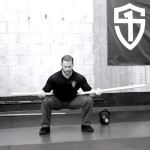
To start the drill, stand tall and place the hands on the top of the front of the thighs. Make a “V” between the thumbs and the finger. Keeping the arms straight, push the hands down the thighs, only hinging about the hips—do not allow the spine to bend. Stop as the hands reach just above the kneecap and robustly grab around the knee. This is the short stop squat.
Check the position of the knee. If you drew a vertical line down from the knee, it will fall between the balls of the feet and the heels. This ensures the hips are well behind. Play with your balance so you feel the center of pressure from the ground in the middle of your feet.
Enjoy carrying the weight of your upper body down the arms and onto the thighs. Focus on the curves in your torso – are they the same as when you were standing? If they are you have good form. If they are not, adjust them back to the natural curves.
To lift from this position, many will shrug. You will not. You will perform the “anti-shrug” by compressing the shoulders down into your torso with co-contraction of the pectoral and latissimus dorsi muscles. This stiffens your torso with the normal curves intact.
To stand up, you must think differently. Do not think about lifting with your back. Instead, think about stiffening your back and torso and the rising motion happens by simply pulling your hips forward as you slide your hands up your thighs. Practice this stiffening and movement sequence.
How to Pull Using What You Learned from the Short Stop Squat
Now it is time to pull. Adopt the short stop position with your hands on your thighs. Grip the ground with your toes and heels. Begin the anti-shrug. Now grab the bar with a double overhand grip. Try and bend the bar with external shoulder rotation. Imagine “gathering” your back adding to the stiffness. Squeeze the bar harder, thinking about force in all your fingers—not just the first and second. Add some more effort to “spread the floor” through the hips.
Now you have torso stiffness approaching optimal and it is time to pull the hips forward. The load will rise from the floor, and you have perfected a form that enables heavy pulls with an injury-resilient body.
You may also like:

You can learn more about Dr. mcGill’s work in his book “Ultimate Back Fitness and Performance” available on his site, BackFitPro.
I’m late to the party on this, but I just started looking through “Simple and Sinister” and came upon this drill. One question I have is about the back. Is the back to be more ‘straight’ rather than ‘curved’ at all? I tried it for the first time today and seemed to really want to curve my back (flexion) rather than flat or rounded.
Thanks!
t
Excellent article. I’ve intuitively been using this drill with clients for some time, but this description is far deeper and it explains things much more clearly. This sort of information is priceless and what I’ve consistent found in the articles and interviews of Dr. McGill. Looking forward to more StrongFirst & McGill in the future.
I have a question: Mr. McGill says here ‘many will shrug. You will not. You will perform the “anti-shrug” ‘ I am curious as to why, exactly, the anti-shrug? I have been reading Stuart McRobert’s “The Insider’s Tell-All On Weight-Training Technique, Revised 3rd Edition” and he explains to shrug. Is his book *not* a good resource on technique?
Michelle, a shrug is an exercise of its own, for the purpose of trap development, or a part of an Olympic pull. In the DL it just weakens you and makes your back more vulnerable. Watch DL videos of a elite powerlifters; none shrug.
Thank you! I like the idea of watching *elite* powerlifters for technique. I find it disappointing that a book that purports to promote safety actually endorses an unsafe technique.
Michelle, some things powerlifters do are unsafe; the “anti-shrug” is not one of them. I have never seen Prof. McGill endorse an unsafe practice.
This can be used to set up for cleans and snatches also?
Barbell, of course.
I’m not sure if I got this right. I understand how to get into the short stop position. But how do I continiue? Is this set-up meant for a partial pull from knee-heigth only? What’s the best way to reach further down for a full ROM pull (DL) and keep the right alignment then?
Daniel, note the sensation (in your lats, among other places), and keep hinging lower. A partial pull is where you start though.
As a woman new to exercise, I’ve been trying to learn as much as I can about good form before I try my first deadlift. I see way too many “dudes” doing it wrong. This is simply the best description I’ve read! Now I’ve gone and ordered the book. . . After pregnancy and everything else a mom goes through, I definitely want to take better care of my back now and make sure it’s strong in all the right places!
Stu McGill is the man, who definitely deserves more notoriety and exposure. Fine article
Great article–wealth of info in a clear ,concise ,easy to apply form.Thankyou for sharing.